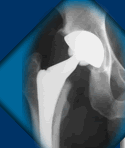
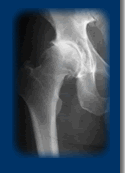
Hip dysplasia is an abnormality of the hip that often develops
before and after birth and possibly later during the adolescent
growth spurt. Grossly unstable hips are usually diagnosed
and treated in infancy and any residual problems typically
become manifest later in adulthood. At least 2/3rds of patients
with hip dysplasia were not aware of any abnormality of the
hip until they experienced hip painas an adult. The problem also tends
to run in families and is most pronounced in womin. In fact, approximately 90% of dysplastic hips that require surgical
correction are in girls and women. In contrast, if hip dysplasia is diagnosed in a boy or man, it can often be traced to genetics. Accordingly, it may be even more important for men diagnosed with this condition to inform their siblings and offspring as they may benefit from examination and having a single x-ray of their pelvis to see if they too have hip dysplasia.
Most hip dysplasia involves under-development of the socket,
or acetabulum. This is referred to as acetabular dysplasia.
If the joint is round and rotates well and the hip does not
have advanced arthritis, the hip is usually best treated by
periacetabular osteotomy.
Sometimes, the ball of the femur is abnormally developed and this is referred to as femoral dysplasia. Femoral dysplasia can occur independently or in combination with acetabular dysplasia. If the femoral dysplasia occurs independently and the hip is not completely worn out, it can often be corrected by femoral osteotomy. This procedure is designed to correct the deformity and is usually performed in combination with hip arthroscopy to deal with whatever cartilage tears may have occurred.
If the hip is affected by both acetabular and femoral dysplasia, the problem can sometimes be treated by simply correcting the acetabular dysplasia. More severely involved hips require correction of both the acetabulum and femur.
Dr. Murphy has treated dysplastic malformations of the hip for more than 20 years. His work in this area includes:
- quantification of the three-dimensional malformations
- prediction of the joint contact pressures in the dysplastic hip
- prediction of joint contact pressure reduction achieved by periactetabular osteotomy, and
- Study of the natural history of untreated dysplasia.
Related work includes refinements of surgical techniques for periacetabular osteotomy and methods of predicting outcomes following surgical correction.
For more information about hip dysplasia, click on
the links below.
Note: You must have Adobe Reader 6 to save PDFs to
your personal computer and to print them.

|