|
|
 |
|
 |
Computer-assisted surgical navigation of the hip is a relatively
new field. Dr. Murphy has been a leader in this field since its inception. His contributions to surgical navigation of the hip include having performed the first peri-acetabular
osteotomy with navigation of repositioning of the acetabular component in 1995, the first total hip replacement with navigation of the femoral component in 1997, the first hip replacement with fluoroscopic navigation in 2001, the first computer-assisted arthroscopic osteochondroplasty for femoroacetabular impingement in 2001, and the first computer-assisted acetabular osteochondroplasty using 2D-3D matching in 2006. He has routinely replaced hips using surgical navigation since 2001.
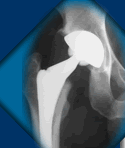
Regarding total hip arthroplasty, one of the most critical technical challenges involves accurate placement of the acetabular
component. Using surgical navigation methods to track the position of the pelvis and the relative position of the acetabular component as it is being implanted is the most reliable method of performing this step of the procedure. Proper acetabular
cup positioning can be challenging because the patient's pelvis
moves around during hip replacement surgery and it's impossible
to know the exact position of the pelvis at the moment that
the acetabular cup is being inserted unless the motion of
the pelvis is tracked during surgery. Even taking xrays during
surgery has limitations because the exact angle of the xray
is not known so precise measurements are difficult to make.
Acetabular component malposition can lead to an increased
likelihood of a number of problems including accelerated wear
of the hip, bone loss around the hip due to the wear debris,
impingement of the components, or dislocation of the hip and
can lead to repeat surgery for any of these problems. Using
computer assistance to measure the position and orientation
of the acetabular cup during its insertion is a very important
application of surgical navigation since improved component
positioning inevitably leads to a lower incidence of all of
these problems.
Computer-assisted surgical navigation of acetabular component implantation involves calculating and tracking the position of the pelvis during surgery and then calculating the position of the prosthetic acetabular component relative to the pelvis as it is being implanted.
Dr. Murphy has performed more than 800 hip arthroplasties using surgical navigation to date which is the largest series of image-guided hip arthroplasties in North America and probably anywhere. He is also the immediate past president and executive board member of the International Society for Computer Assisted Orthopedic Surgery.
Most of these computer-assisted total hip replacements are
also performed using tissue-preserving, minimally invasive
techniques. The combination of less-invasive surgical techniques
and image-guided surgical navigation holds much greater promise
than either of the new techniques alone. When considering
all of these issues though, each patient should remember that
the true goal of hip replacement surgery is to have a well
functioning hip for 10, 20, or 30 years. Whether a patient can
walk well without crutches at 3 or 6 or 9 or 12 weeks isn't
really the most important issue. All of our newer techniques
must always be thought of with the long-term goals in mind.
For more information about computer-assisted surgical navigation,
click on the references below.
Publications:
Note: You must have Adobe Reader 6 to save PDFs
to your personal computer and to print them.

|
|
 |
| |
|